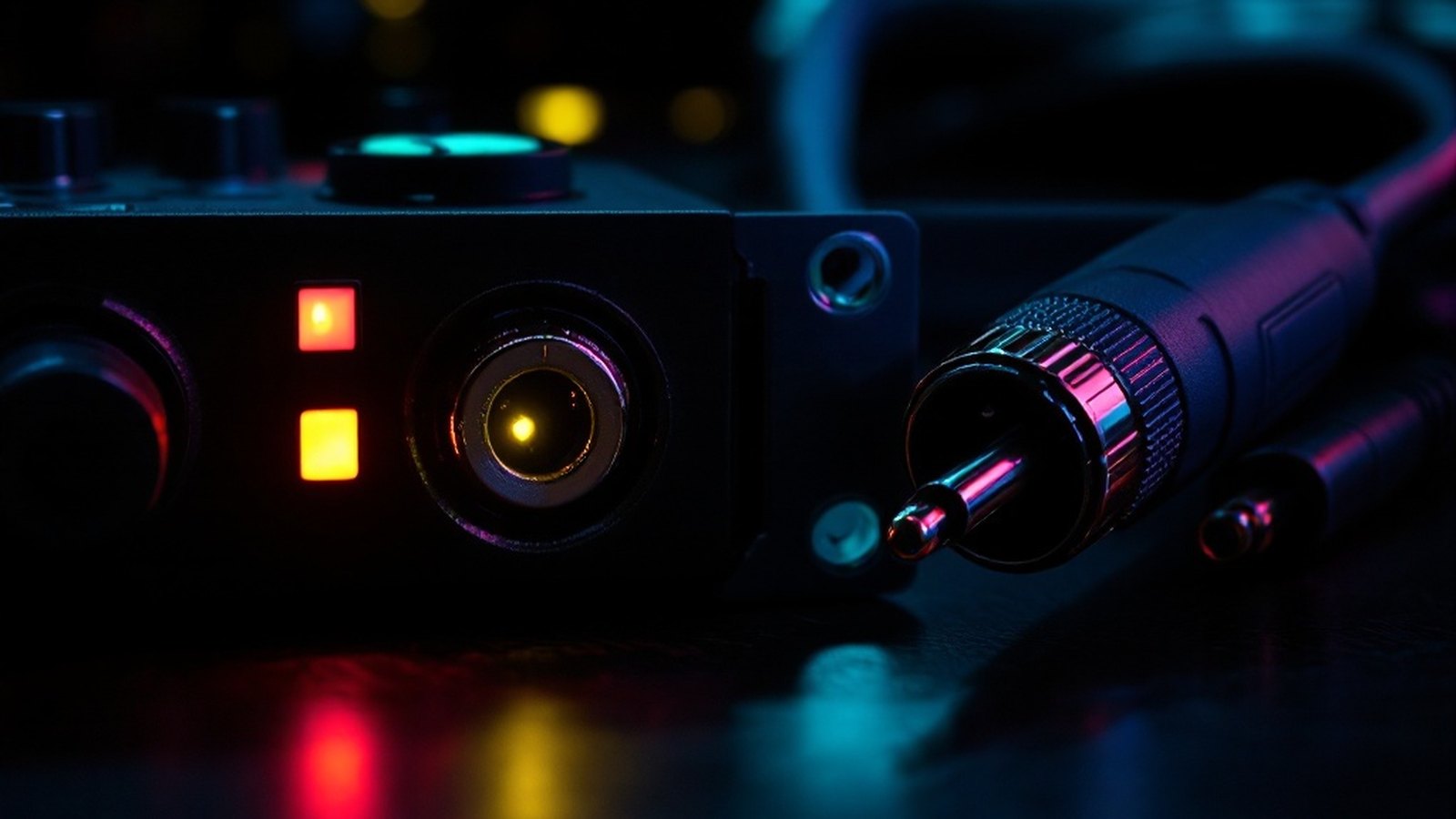
A MIDI cable carries zero sound. Once that clicks, the whole studio makes sense.
01They Look Similar. They Do Completely Different Jobs.
Plug a MIDI cable between a keyboard and a computer and press a key. You'll hear nothing — not because something's broken, but because MIDI was never meant to carry sound. What travels down that 5-pin DIN connector is data: a compact stream of MIDI messages describing what you played. Note number, velocity (how hard you hit the key), timing, duration. The receiving device reads those instructions and decides what sound to make. The keyboard is basically sending a very precise "play this note, this loud, right now" command.
Audio cables do the opposite. They carry an actual electrical representation of a waveform — analog voltage variations that mirror the rise and fall of sound pressure. Record that waveform, store it as a file, play it back: what you hear is a direct capture of what entered the microphone or line input. There's no intelligence in it, just signal.
That distinction is why MIDI is so powerful. Because the data is abstract — pitch and velocity, not sound — you can route the same performance to a grand piano plugin today and a string section tomorrow without re-recording a single note. Your DAW stores a sequence of instructions, not a fixed recording. Change the instrument, change the tempo, transpose the key: the performance travels with you.
Audio is committed. Commit a vocal to tape (or a WAV file) and the pitch, timbre, and timing are baked in. Tools like pitch correction can nudge things afterward, but you're working against a fixed signal, not rewriting instructions.
In practice, most studios use both constantly. A producer might play a chord progression on a MIDI controller — a device with no internal sounds of its own, just a sender of performance data — into a Steinberg Cubase session running a Yamaha-modeled piano plugin. That's MIDI doing its job. Then they record a live guitarist through a Focusrite audio interface, capturing actual waveform data as a WAV track. Two cable types, two fundamentally different philosophies, one session.
The confusion usually shows up when someone expects to plug a keyboard's MIDI out into a speaker and hear music. You won't — because the speaker can only play audio, and MIDI is just a set of instructions waiting for an instrument to act on them. Think of MIDI as sheet music and audio as the recording of the performance. Both matter. Neither replaces the other.