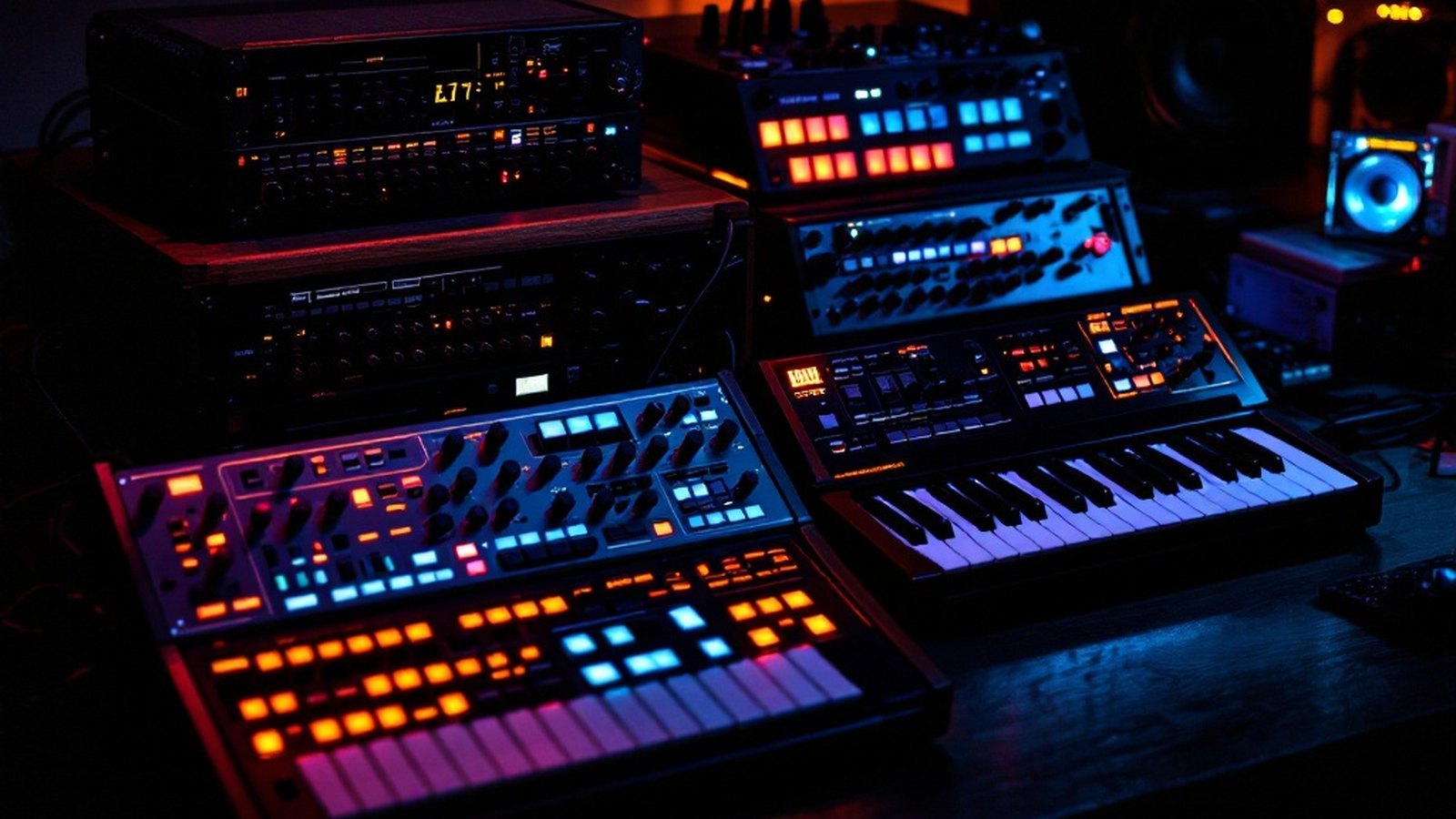
Four purpose-built instruments that cover drums, bass, synthesis, and vocals — no laptop required.
01Why Hardware, Why Now
Producing music without a computer used to mean one thing: a standalone drum machine and not much else. Today the options are dramatically broader, and Roland's AIRA collection is one of the clearest answers to the question of whether a musician can build a full production rig — drums, bass, synthesis, vocals — without ever opening a DAW.
AIRA launched in 2014, applying Roland's Analog Circuit Behavior (ACB) technology to revive its most iconic hardware. ACB doesn't replay recorded samples; it mathematically models original analog circuits at the component level, so the sound responds dynamically to how you play, much like genuine analog hardware does. The collection centers on four units: the TR-8 Rhythm Performer, TB-3 Touch Bassline, VT-3 Voice Transformer, and System-1 Plug-Out Synthesizer. Each connects to a computer via USB if you want it to — but none requires one to function.

02The Four Units, Plain and Simple
TR-8 Rhythm Performer sits at the rhythmic core. It combines TR-808 and TR-909 drum character in one unit, modeled via ACB rather than loaded from samples. Step sequencer layout mirrors the original workflow, so veterans get up to speed immediately. Two additions the originals lacked entirely: onboard delay and reverb, meaning no external routing needed. The Scatter feature lets performers manipulate rhythmic patterns in real time during a live set — a practical tool, not a gimmick.
The Scatter feature lets performers manipulate rhythmic patterns in real time during a live set — a practical tool, not a gimmick.
TB-3 Touch Bassline inherits the squelchy filter resonance and glide that made the original TB-303 the accidental backbone of acid house, while fixing the one thing everyone hated about it: the interface. The original's step-entry system was notoriously cryptic. Roland replaces it with a touchpad that lets you play notes expressively and program patterns simultaneously — two actions collapsed into one gesture. The TB-3 also carries additional synthesizer types beyond the classic 303 model, so producers aren't locked into a single bass texture.
VT-3 Voice Transformer handles the one production role the other three don't cover: vocals. Plug in a microphone, connect to a carrier signal, and a single main knob moves through nine voice transformation modes — classic vocoder, harmonizer, pitch correction, and harder robotic effects. Its compact form factor slots naturally alongside the TR-8 and TB-3 in a live rig, and every function is accessible via physical controls. No software menus, no latency workarounds.
System-1 Plug-Out Synthesizer is the most versatile of the four. It's a two-oscillator synth capable of monophonic play or up to four-voice polyphony, with dedicated knobs and sliders for every key parameter. Its defining feature is Plug-Out architecture: download a licensed vintage synth model — an SH-101 or Juno-106, for example — from a computer onto the unit's internal memory, and the System-1 runs that model entirely standalone from that point on. The computer is needed only for the initial transfer. Switch back to the native AIRA engine with a single button press.

03Can They Actually Stand Alone?
Together, the four units cover the structural components of most modern electronic music: rhythm (TR-8), bass movement (TB-3), processed vocals (VT-3), and melodic synthesis (System-1). Units sync via MIDI and USB clock, so tempo stays locked across the full rig. Crucially, each unit also carries its own clock — run just the TR-8 and TB-3 together and they function as a complete standalone system without the other two present.
The collection scales well. A producer can start with one unit and add others gradually; nothing requires the full set to be useful from day one. On price, AIRA units have historically sat in the mid-range of professional hardware — well below the cost of sourcing and maintaining genuine vintage originals, and competitive with quality software alternatives once you account for the value of physical control and live performance reliability.
For musicians looking to step away from the screen without sacrificing sonic depth, AIRA makes the hardware argument as convincingly as anything in its price class.
The chronology
- 1980–1981Roland TR-808 and TB-303 introduced
- 1983TR-909 released
- 2014Roland AIRA series launched with ACB technology