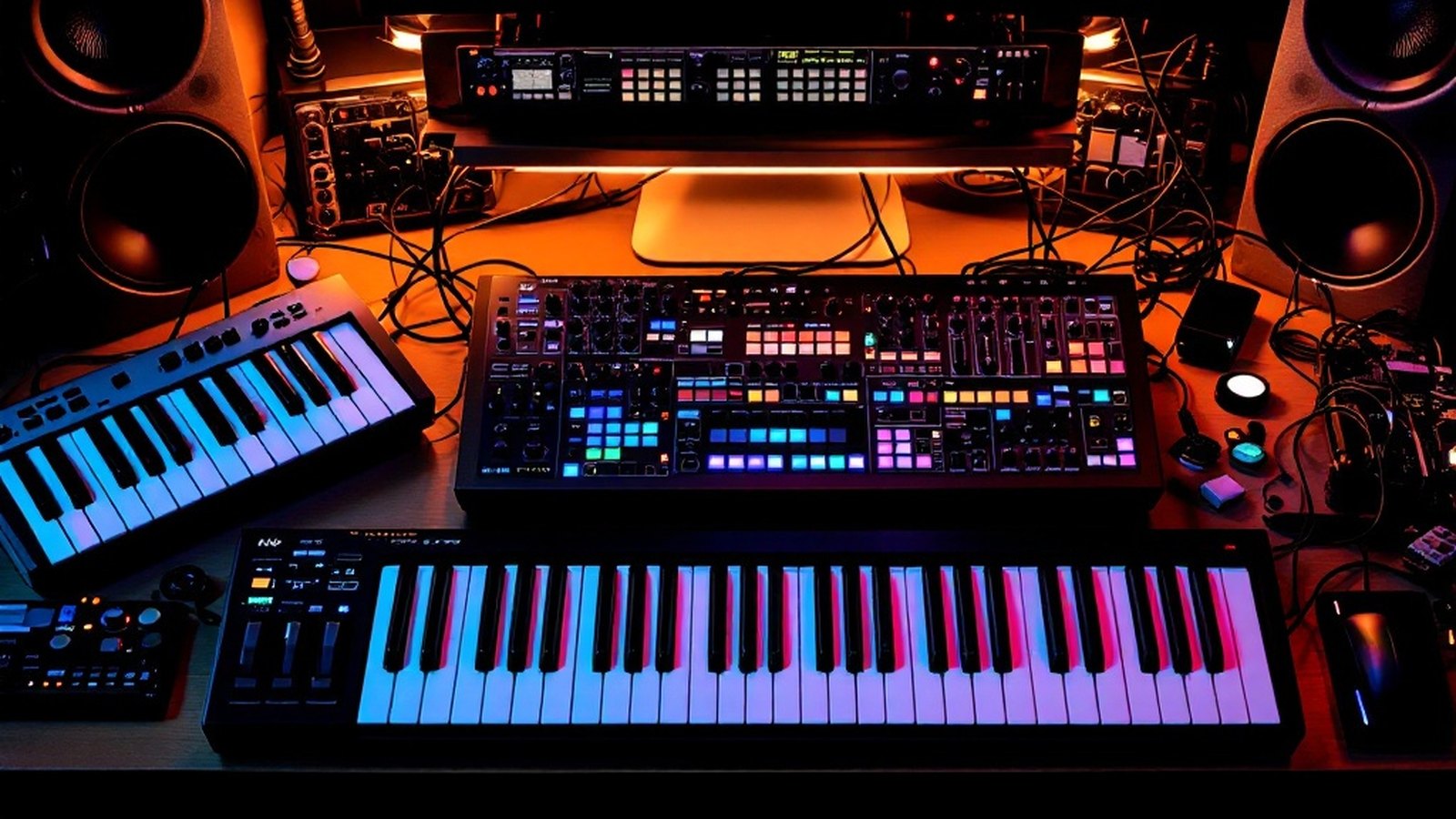
The right key count has more to do with your desk and your workflow than any spec sheet.
01Count Keys, Not Stars
Walk into any gear conversation and someone will tell you that 25 keys is "just for laptop producers" and 88 is the only real option. Ignore both. Key count is a practical constraint, not a ranking, and buying too many octaves is just as much a mistake as buying too few.
The question to ask is not which is best but what will actually fit your setup, your music, and the way you play. Those three answers may point to three different sizes — and only yours matters here.
25 keys is the most compact option, covering just over two octaves. It fits on a corner of a desk next to a monitor, slips into a backpack, and keeps your focus on the DAW rather than the controller. If you produce mostly in software — programming patterns in Ableton, sketching in FL Studio, or triggering samples — you can get a surprising amount done with two octaves because you can transpose on the fly with a button press. The real limitation shows up the moment you want to comp a chord in your left hand while playing a melody with your right, or when you're doing even modest piano-style parts that span more than two octaves without stopping to re-set your octave range. If you are primarily a finger-drummer, a sound designer, or you just need a MIDI controller to sketch melodic ideas, 25 keys is entirely respectable — and the tradeoff in portability is real and worthwhile.
49 keys is where most home-studio producers comfortably land. Four octaves is enough range for left-hand bass notes and right-hand leads in the same take without reaching for the octave shift. Chord voicings that would feel cramped on a 25 don't require mental gymnastics. Synth pads, bass lines, and melody work all feel natural. The footprint is still desk-friendly — generally somewhere around 28 to 32 inches wide, depending on the key width — and most 49-key controllers still travel reasonably well. If your music involves any real-time keyboard playing at all, 49 keys tends to be the point at which playing stops feeling like a workaround.
61 keys is the threshold at which players trained on piano or organ start to feel genuinely at home. Five octaves means you can voice a ballad, play a two-hand organ part, or cover the full range of most synth patches without mentally tracking where you are in the transposed register. The tradeoff is desk space and portability: a 61-key controller typically runs close to 40 inches wide, which is a significant footprint if your studio is also your bedroom. It's also almost universally the right choice if you do any amount of live performance that requires expressive, wide-range playing.

02A Few Things Key Count Can't Tell You
Size isn't everything. A 49-key board with excellent semi-weighted action will serve a pianist far better than a cheap 61-key with spongy mini-keys. Pitch and mod wheels, aftertouch, assignable knobs, and velocity sensitivity all matter more to your daily workflow than adding another octave. Novation, Akai, M-Audio, and others all make solid controllers across these sizes — evaluate the feel and feature set, not just the octave count.
Novation, Akai, M-Audio, and others all make solid controllers across these sizes — evaluate the feel and feature set, not just the octave count.
Also consider what sits next to the controller. If you're already running a hardware synth or a digital piano in your rig, a 25- or 49-key controller might be all you need as a secondary input device. Controllers don't have to handle every musical situation by themselves.
One last sanity check: measure your desk before you buy. Controllers are often listed in key count and ignored in inches. A 61-key board is roughly 40 inches wide, a big share of a typical desk, and that space has to come from somewhere — usually from your audio interface, monitor, and the coffee you need to survive the session.
Buy for the music you're already making, not the player you imagine becoming. The keyboard that matches your desk, your hands, and your actual workflow will always outperform the one that looks impressive in a spec list.